

When a leading marketing certification course labels automated post scheduling as “AI,” it’s clear that social teams have a problem. The trouble is that calling everything AI strips Heads of Social of the vocabulary they need to answer an AI mandate with a plan.
Leadership wants more speed and scale from the same headcount, and “use more AI” is often the entire directive. If your team can’t separate deterministic automation from probabilistic AI, it’s hard to show what already runs on rules, predict costs, or decide where a real person needs to check the work. You also risk paying AI prices for what is essentially a rules engine.
Here’s a real example, to glean how much the lines have been blurred, then a simple way to sort every task your team does.
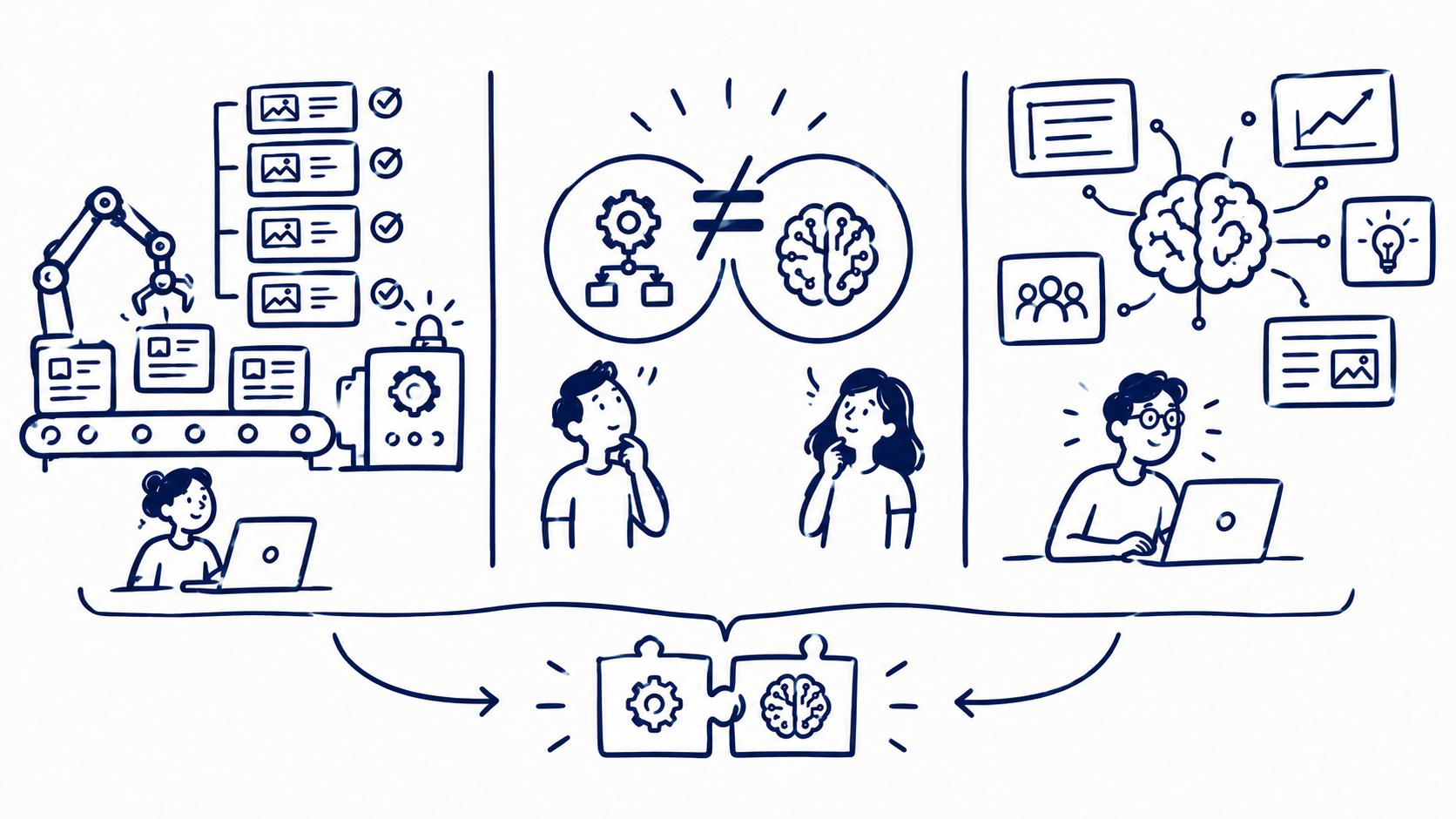
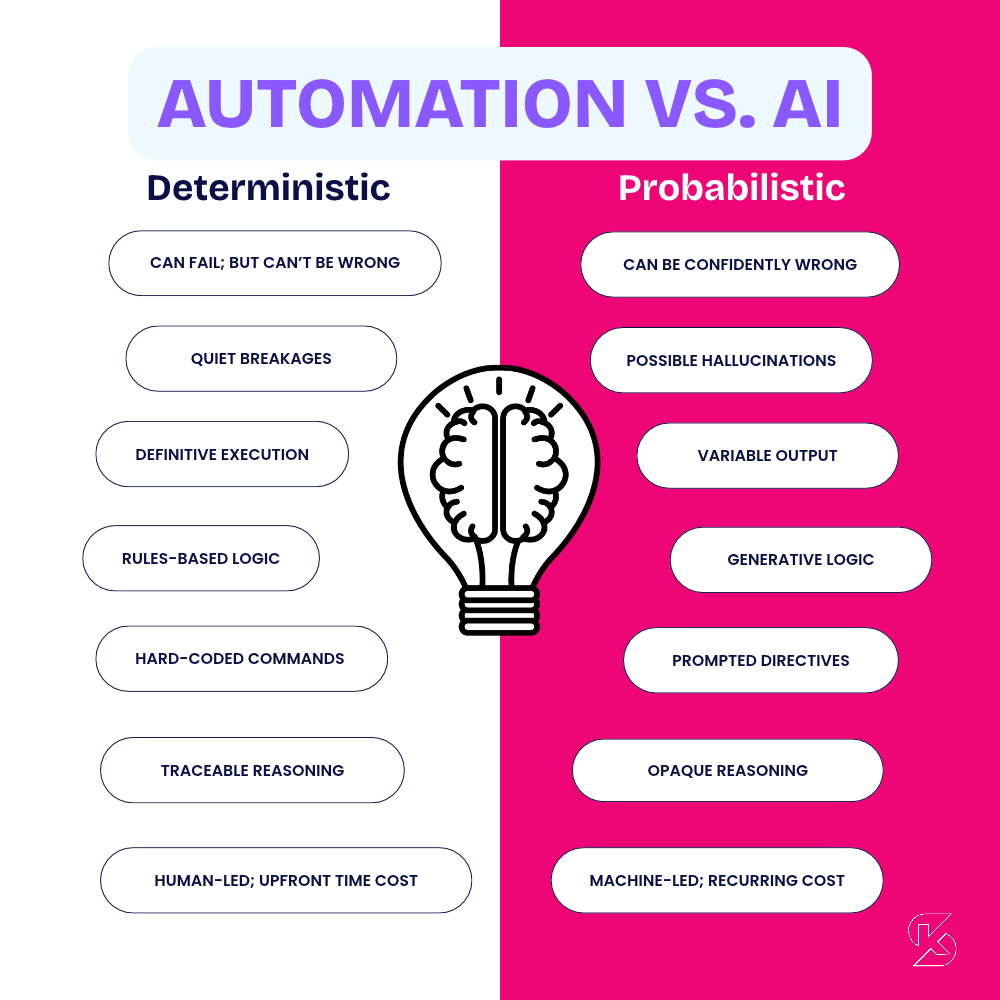
Automation is rules-based: it executes if-then logic, like publishing at a set time or routing a DM, and produces the same outcome every time. AI is probabilistic: it generates outputs like draft replies or listening summaries, which can be wrong and need a person to check them. That distinction decides what you can trust to run itself and what needs a reviewer.
Essentially, automation executes your judgment as designed, and AI supplies judgment where you can’t write the rule. I call that boundary The Judgment Line. Knowing which side of it each step sits on decides whether you build workflows you can trust (deterministic) or add variables that need constant checking (probabilistic).
No. Automated post scheduling is rules-based automation: a post goes out at the time someone set. The confusion is common enough that it showed up on a certification exam I took this fall, while renewing my credentials.
The exam, from a prominent marketing SaaS company, asked: “Which of the following is an example of AI already being integrated into everyday marketing tools?”
The “correct” answer, according to the exam, was automated post scheduling. Anyone who has run social through Sprout Social, Hootsuite or Sprinklr knows scheduling is rules-based automation.
The more accurate answer is keyword suggestion tools, which generate probabilistic recommendations that can miss. When the training materials social teams rely on blur the two, the confusion spreads into how teams plan, budget and govern their work.
Ask one question: can this step be wrong? If yes, it leans toward AI. If no, it’s automation. That single test is enough to sort nearly any recurring task your team runs without a lengthy audit.
A 9 AM publishing trigger can fail, but it can’t be wrong. A keyword tool infers suggestions from patterns, so it can be wrong, which is exactly why it’s useful for surfacing possibilities.
The same test sorts social work. A rule like “product posts publish Mondays between 4 and 6 PM” is pure automation: if it’s Monday, in that window, and tagged as a product post, publish. Routing every inbound DM that mentions a refund to the care queue is automation too. Drafting a first reply to a frustrated customer is AI territory, because the right words depend on judgment no rule captures.
Both, in sequence. When a platform assesses engagement data to suggest the best posting times, that workflow may well involve AI; when your scheduling tool publishes based on that suggestion, the execution step is automation.
I highly support this collaborative pairing when it makes sense: AI supplies the judgment about timing, and automation carries it out. The exam said “automated post scheduling,” though, which makes the AI label misleading at best.
They overspend, lose traceability, build less reliable workflows and miss the human checkpoints that protect the brand. Each of those is a question leadership will eventually ask, and the answer needs to be ready before the question comes.
Cost. Rules engines are inexpensive to run. Generative models cost more per use, and the bill grows with volume. Putting AI where a well-defined rule would work spends budget and provides variability when it might not be needed.
Traceability. Automation rules are documented and visible as they almost always come with an execution log for on-demand review. When legal or a regional lead asks why a post went out at that moment, you can point to the exact rule that fired. With AI, the same prompt and input can send a model in several directions, so the path is never fixed in advance or thoroughly traceable to the result.
Reliability. Automation delivers repeatable outcomes unless someone changes the workflow. AI needs prompting, review and adjustment to stay reliable. If a task has to run the same way every single time, automation is the safer owner.
Brand risk. Every AI-powered step needs a person who checks the output before it moves forward. I call that practice Always Intervene Meaningfully. If your team doesn’t know which steps are AI, it can’t know where those checkpoints belong, and unchecked output ends up on your channels which produces brand risk.
Sort every task with three questions: can we write the rule, does it need judgment we can’t configure, and is human connection the value? It’s a practical sequence that works both for teams eager about AI and those who are wary of it.
Most social workflows need all three working together, but the skill is knowing which one each step needs.
It turns “use more AI” into a plan leadership can fund: what already runs on rules, where AI adds value and where a person stays in charge. Precise language is helpful in three conversations.
Start by mapping the work: list your team’s recurring tasks and sort each one with the three questions above. Do this before committing to new tools or budget, so you know what you already have and what you actually need.
Mark every AI step with the person who checks it. Along the way, look for places where you pay for AI but use only rules-based features, and for places where AI could supply judgment your team spends hours on now.
Automation executes your judgment as designed. AI supplies judgment where you couldn’t write the rule. People own the moments where connection is the point. Getting that foundation right is what lets your team move faster while the brand stays protected.
If you want a clear read on how your team operates today, start with the Social Operations Map. It shows how your team’s work runs and where the quickest operational wins are.
The CMO 5-Minute Briefing
A short, actionable briefing for marketing executives: what's shifting in social, why it impacts your bottom line, and one precise question to bring to your next 1:1 with your Head of Social.
One email a week. Unsubscribe any time.